When we design networks, we usually expect hosts to communicate with devices in other subnets through a default gateway. Each subnet is a separate broadcast domain, and ARP is only used for local communication.
But what happens if hosts are misconfigured and don’t have a proper default gateway? This is where Proxy ARP comes into play.
Proxy ARP is a feature where a router answers ARP requests on behalf of another device, making hosts believe the destination is directly reachable on the local network.
In this lab, we have two different subnets:
- 172.16.0.0 /16 (top side)
- 172.16.1.0 /24 (bottom side)
All hosts must communicate with each other without changing IP addresses.
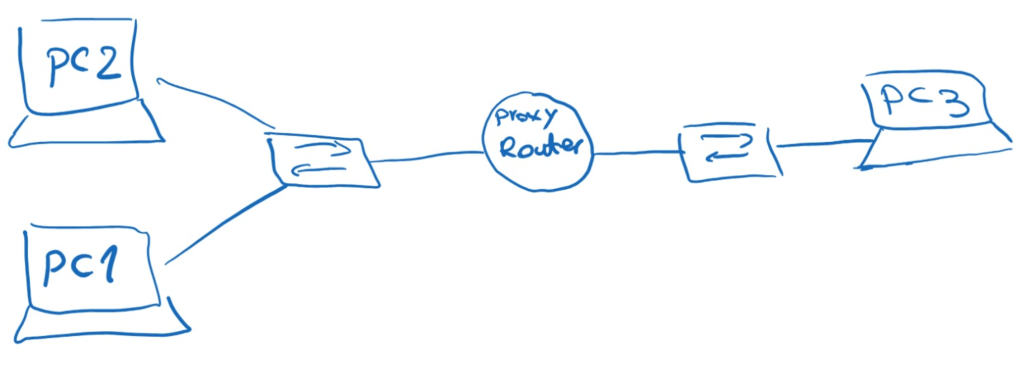
Let’s say PC 1 (172.16.0.1) wants to reach PC 3 (172.16.1.4).
From PC1’s perspective: Destination is in a different subnet but if no default gateway is configured (or misconfigured), it will: Send an ARP request for 172.16.1.4.
Problem is PC3 is not in the same broadcast domain so no one answers → communication fails.
With Proxy ARP enabled, the router does something clever:
- PC1 sends arp for 172.16.1.4
- Router replies using its own MAC address (It uses the MAC address of Proxy’s f0/0 interface)
- PC1 now sends traffic to Proxy
- The router routes the packet to the correct destination (PC3)
From PC1’s point of view, it thinks PC3is directly reachable.
On Router:
interface f0/0
 ip proxy-arp

Leave a Reply